
Finding the best golf irons of 2026 isn’t as simple as reading one review.
To build this guide, I spent three weeks analyzing the biggest independent equipment tests, reading feedback from real golfers, comparing launch monitor data, and reviewing expert opinions from Golf Monthly, Plugged In Golf, MyGolfSpy, and experienced club fitters.
That’s the approach behind every guide on USA Golf Guy: multiple sources, real data, and honest trade-offs.
The goal was simple: identify the best golf irons that golfers can actually buy and trust.
One of the largest tests of the year, MyGolfSpy’s 2026 Most Wanted Players’ Irons, evaluated 15 models and recorded more than 14,400 shots.
While the testing produced valuable data, it excluded several popular players’ irons from brands like Mizuno, Cobra, and TaylorMade.
It also featured irons that aren’t widely available through major retailers, making it difficult for many golfers to purchase the clubs they recommend.
That’s why I created this guide to the best golf irons 2026 has to offer.
Every recommendation is based on independent testing, verified golf iron reviews, real golfer feedback, detailed specification analysis, and current retail availability.
I haven’t personally tested every iron in this list, and I won’t claim otherwise.
Instead, I’ve combined the most reliable research into one resource to help you compare the best players’ irons, understand the differences between today’s top-rated golf irons, and confidently choose the right iron set for your game.
What Makes the Players' Irons Different
Before we rank anything, let’s get clear on what this category actually is.
A player’s iron is built for golfers who prioritize control over forgiveness.
You’re looking at thinner top lines, less offset, traditional lofts, and compact blade lengths.
The tradeoff is simple: you get more shot-shaping ability and precision, but mishits punish you harder.
If you’re a mid-to-high handicapper, this probably isn’t your category.
And if your long irons aren’t carrying far enough, a fairway wood might fill that gap better than forcing a 3-iron. I tested the best fairway woods tested by Toby: 15 fairway woods across the same sources.
Check out players’ distance irons or game improvement irons instead.
No shame in that; the right iron for your game beats the prettiest iron in someone else’s bag every time.
How I Chose the Best Golf Irons
Performance data. I started with MyGolfSpy’s 2026 Most Wanted test (260 hours of testing, 20 low-handicap testers, and GCQuad data) and pulled every iron that scored above 8.0 overall.
Then I cross-referenced those results with independent reviews from Plugged In Golf, Golf Monthly, National Club Golfer, and The Hackers Paradise.
Availability. Six of the top finishers on MyGolfSpy can’t be bought through normal retail channels. Ballistic CB is direct-to-consumer only, LA Golf CB-26 isn’t even released yet, PING restricts Amazon distribution, Takomo sells DTC, and both ONOFF and Fourteen are Japanese domestic market specialties.
I replaced those with major-brand players’ irons that were excluded from the MyGolfSpy test but have strong independent data behind them.
Amazon availability. Every iron on this list has a verified Amazon listing.
If you’re buying golf irons in 2026, that matters for price comparison, return policies, and yes, affiliate transparency. I use Amazon affiliate links on this site. You should know that.
The 15 Best Players' Irons of 2026
Titleist T150 | Best Golf Irons Overall

The T150 won MyGolfSpy’s 2026 Most Wanted Players’ Irons test outright, and it wasn’t because it was the most accurate iron in the field.
It won because it does everything well. Distance score of 9.7, forgiveness score of 9.1, and a respectable 8.6 for accuracy. That balance is rare in this category.
Titleist describes this as a “tweener,” something between a pure players’ iron and a players’ distance iron.
The lofts are 1 degree stronger than the T100, there’s an improved muscle channel through the 7-iron, and the Variable Face Thickness technology keeps ball speed consistent across the face.
The dual D18 tungsten weighting is hidden inside the head, so the look at address is clean and compact.
Multiple testers noted the consistency above everything else. The carry distance deviations were among the tightest in the entire test.
| Pros | Cons |
|---|---|
|
|
Scroll to see more features
Srixon ZXi7 Best Players' Iron All-Rounder

The Srixon ZXi7 is one of the top-rated golf irons of 2026 and quickly became one of the most talked-about players’ irons after the MyGolfSpy testing results.
It earned an impressive 8.9 overall score, tying for second place while delivering one of the most balanced performances among the best golf irons tested.
Its scores 8.9 for accuracy, 8.8 for forgiveness, and 9.1 for distance make it one of the most accurate golf irons and a strong contender for golfers seeking consistency in every aspect of their game.
Srixon’s proprietary i-FORGED manufacturing process uses condensed forging technology to create a softer S15C steel body while maintaining exceptional strength around the hosel.
Combined with the expanded PureFrame behind the sweet spot and the proven Tour V.T. Sole, the ZXi7 delivers the premium feel, turf interaction, and control expected from the best players’ irons on the market.
These technologies help explain why many golfers and fitters consider it among the best irons for golf this year.
It’s also worth remembering that the ZXi7 won the 2025 MyGolfSpy Most Wanted Players’ Irons test against a larger field that included the Titleist T150.
Although it narrowly finished behind the leaders in 2026, the difference was minimal, proving that the ZXi7 remains one of the best golf irons of 2026 and a top choice for golfers who value balanced performance over a single standout category.
| Pros | Cons |
|---|---|
|
|
Scroll to see more features
Wilson Staff Model XB | Best Value Golf Iron

Wilson’s 2026 Staff Model lineup has been getting serious attention, and the XB earned it.
It finished fifth overall in the MyGolfSpy test with an 8.8, posting a 9.5 accuracy score second only to the Ballistic CB and LA Golf CB-26, neither of which you can easily buy.
The XB uses a forged hollow-body design with an AI-developed face, which is a lot of technology for a $1,100 price tag.
The Fluid Feel Hosel eliminates unused weight and shifts it toward the toe for better stability. The precision-milled face extends ball-to-face contact time for more consistent spin.
There’s an argument in the MyGolfSpy comments that the XB belongs in the players’ distance category rather than the players’.
The data muddies that line; its carry distances were virtually identical to the Staff Model CB despite the different construction. Either way, at this price, it’s stealing from irons that cost $400 more.
| Pros | Cons |
|---|---|
|
|
Scroll to see more features
Callaway Apex Ai 150 | Best Players' Distance iron

If raw distance is what you’re chasing in a player’s iron, this is where the data points. The Apex Ai 150 scored a 9.8 for distance in the MyGolfSpy test, the highest distance score of any iron in the field.
It produced the fastest ball speeds (113.85 mph average) and longest carries (161.93 yards on the 7-iron) among all 15 tested models.
The Ai10x Smart Face uses actual player swing data and AI to optimize spin and speed across the hitting area.
The 455 face cup in the long and mid irons (3i-7i) generates ball speed that frankly doesn’t belong in a head this compact. The 17-4 stainless face in the scoring irons (8i-W) transitions seamlessly.
Here’s the honest caveat: the Apex Ai 150 scored 8.3 for accuracy and 7.9 for forgiveness.
Those aren’t bad numbers, but they trail the leaders. Multiple testers described the distance control as “horrible” on off-center strikes, then added that when they found the center, it was unlike anything else.
That tells you everything about who this iron is for.
| Pros | Cons |
|---|---|
|
|
Scroll to see more features
PXG 0311T GEN 8 | Best Golf Iron Brand

PXG’s GEN8 T is the most compact iron in their lineup, and the Dual Perimeter Weighting system is the real differentiator.
You can independently adjust heel and toe weights from 2 g to 12 g in 1-gram increments without changing lie or loft. That’s a level of fitting granularity no other iron on this list offers.
In the MyGolfSpy test, the 0311T GEN 8 scored 8.2 overall with an 8.4 accuracy and 8.3 distance.
Middle of the pack. But the stock configuration test doesn’t capture PXG’s real advantage, which is the fitting experience.
The QuantumCOR polymer behind the ultra-thin HT1770 maraging steel face maximizes energy return while dampening vibration.
When dialed in by a fitter who knows the weight system, independent reviewers, particularly Plugged In Golf, have raved about the forgiveness-to-size ratio.
| Pros | Cons |
|---|---|
|
|
Scroll to see more features
Wilson Staff Model CB The Purist's Pick
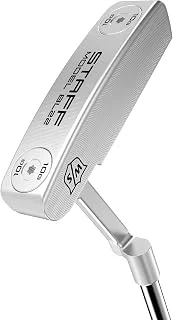
The Staff Model CB is about as traditional as a 2026 players’ iron gets. One-piece forged from 8620 carbon steel with a Tri-Brace Stabilizer in the cavity, 20 grams of tungsten in the long-iron toes, and precision-milled grooves.
No hollow body, no AI face, no polymer cores. Just a really well-made cavity back iron.
It scored 8.2 overall in the MyGolfSpy test, an 8.1 for accuracy, 8.7 for forgiveness, and 7.7 for distance.
That forgiveness number is notable for an iron this traditional. The Tri-Brace design transfers more energy at impact while also improving the sound profile; testers described it as “pure.”
At $1,000, it’s the second most affordable iron in the test field. Combined with its traditional lofts (34° 7-iron), this is the iron for the golfer who thinks the game has gotten too gadget-heavy.
| Pros | Cons |
|---|---|
|
|
Scroll to see more features
Titleist T100 The Top-Rated Golf Irons
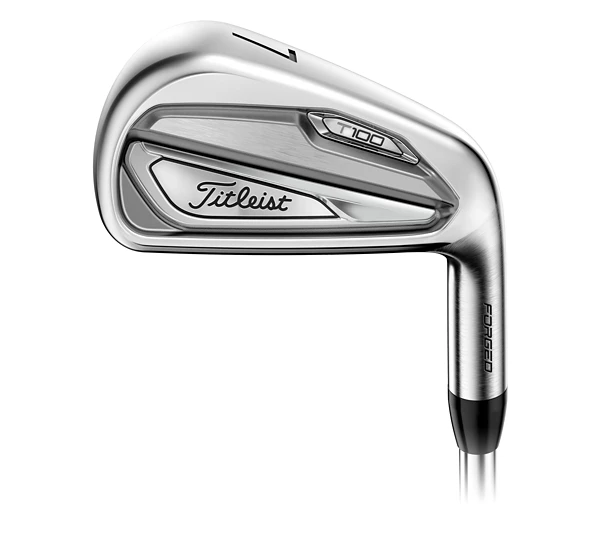
The T100 is the most played iron on professional tours worldwide, and the 2025 update refined what was already an outstanding design.
It scored 8.1 overall in the MyGolfSpy 2026 test, which might look disappointing until you understand why.
The T100’s accuracy score of 7.6 was genuinely surprising.
But its forgiveness score of 9.1 tells a different story: this is one of the most consistent irons ever tested.
The Variable Bounce Sole, refined with input from Vokey’s grind team, flows through turf faster than any previous generation.
The new VFT face maintains speed across the striking area, and the progressive groove design in the scoring irons generates spin in wet conditions and rough.
The gap between the T100 and T150 comes down to one question: do you want an extra degree of loft and a fraction more precision, or do you want more speed and a slightly larger head? Tour pros who need to flight the ball and control trajectory pick the T100.
Everyone else should probably look at the T150.
| Pros | Cons |
|---|---|
|
|
Scroll to see more features
TaylorMade P770 | best golf iron brand
The P770 wasn’t included in the MyGolfSpy 2026 test, and that’s a significant omission.
This is one of the most popular players’ irons on the market, and independent reviews from Plugged In Golf and Golf Monthly have been consistently positive.
The 2026 update refined the shaping for better turf interaction and introduced FLTD C technology, essentially optimizing center of gravity placement that creates high launch in the long irons and lower, spinning shots in the scoring irons.
Each head is forged with up to 46 g of tungsten weighting, and the Thru-Slot Speed Pocket maintains ball speed on low-face strikes.
The P770 sits right between the P7MC (pure feel) and the P790 (maximum distance).
If that sounds like where the T150 lives in the Titleist lineup, you’re right, and the head-to-head comparison between these two is one of the most interesting fitting conversations in golf right
| Pros | Cons |
|---|---|
|
|
Scroll to see more features
Mizuno Pro 245 | Best New Golf Iron

Mizuno’s omission from the MyGolfSpy test was the single most-criticized decision in the comments.
The Pro 245 is the third generation of their “hot metal blade” concept, a hollow-body iron made with 4135 Chromoly that looks like a traditional muscle-back at address.
The Grain Flow Forging process happens at Mizuno’s facility in Hiroshima, Japan.
The multi-thickness CORTECH face generates ball speed that puts it in players’ distance territory, but the head shape, topline, and offset are pure players’ irons.
The scoring irons (9-GW) transition to a partial hollow 1025E steel construction for better flight control and accuracy where it matters most.
The copper underlay beneath the nickel chrome finish produces a feel at impact that Mizuno owners describe with an almost religious devotion.
If you’re chasing that forged feel in your irons, your glove matters too; a thick synthetic will mask it. I ranked the best golf gloves on grip, feel, and durability.
That’s not hyperbole; it’s the reason people switch to Mizuno and don’t switch back.
| Pros | Cons |
|---|---|
|
|
Scroll to see more features
Mizuno Pro 241 | Best-Looking Golf Iron

The Pro 241 is what happens when a manufacturer says, “We’re not going to add technology to this; we’re going to remove everything that doesn’t need to be here.”
One piece of 1025E Pure Select steel, Grain Flow Forged in Hiroshima, with concentrated mass directly behind the impact zone.
No hollow body. No face cup. No tungsten. Just a forged muscle back with Harmonic Impact Technology that fine-tunes the head geometry for feel and feedback.
The copper underlay is here too, adding that signature Mizuno impact sensation.
This is the least forgiving iron on this list by a wide margin. It’s also the most rewarding when you strike it properly.
If you carry a single-digit handicap and your miss pattern is tight enough to trust a traditional blade shape, the 241 will tell you exactly what you did on every swing.
| Pros | Cons |
|---|---|
|
|
Scroll to see more features
TaylorMade P7MC | Best Iron for Golf Accuracy

The P7MC was designed with direct input from TaylorMade’s tour staff, and it shows.
Compact Grain Forging uses a 2,000-ton press to produce a tighter grain structure than standard forging, and every face is machined for consistency.
The muscle cavity design adds a touch more forgiveness than a pure blade while keeping the feel, sound, and workability that better players demand.
The most aggressive score-line geometry TaylorMade has ever produced makes this a control-first iron.
The progressive offset gets tighter through the set, and the narrow sole with a tight leading edge promotes clean turf contact.
Independent reviews consistently place the P7MC alongside the Mizuno Pro 241 and Titleist T100 as the three benchmark pure players’ irons, each with a different flavor of the same
| Pros | Cons |
|---|---|
|
|
Scroll to see more features
Cobra KING Forged Tec X Forgiveness in Disguise

The KING Forged Tec X blurs the line between players’ irons and game improvement more than any other iron on this list and does it without looking like a game improvement iron.
The hollow body is injected with flexible foam for an elastic rebound effect, and 65 g of tungsten (45 g more than the standard Forged Tec) drives the CG low and stable.
The PWRSHELL face cup design increases ball speed across a wider area than a traditional face, and CNC milling typically reserved for pure players’ irons ensures precise lofts and groove shapes across every head.
Here’s the catch: the 28° 7-iron loft makes this the strongest-lofted iron on the list by a significant margin.
Your 7-iron is essentially a traditional 6-iron. If that doesn’t bother you and you want maximum forgiveness in a compact shape, the Tec X delivers. If gap consistency across your set matters, pay attention to your wedge setup.
| Pros | Cons |
|---|---|
|
|
Scroll to see more features
Cobra KING Tec | Top Golf Iron
The 2025 KING Tec is Cobra’s direct competitor to the P770 and T150.
Five-step forging from 1025 carbon steel, a hollow body filled with softer foam than the Tec X, and a forged 4140 PWRSHELL insert with H.O.T.
Face Technology. The 20 g of tungsten in the toe provides stability without the extreme weighting of the Tec X.
This is the iron for golfers who like what Cobra is doing but want a more traditional players’ iron experience than the Tec X offers.
The lofts are more reasonable (30° 7-iron), the head shape is more compact, and the feel is closer to a traditional forged iron thanks to the softer foam and refined forging process.
| Pros | Cons |
|---|---|
|
|
Scroll to see more features
TaylorMade P790 | Most Popular Golf Iron

I’m including the P790 because the line between “players’ iron” and “players’ distance iron” has gotten so thin that ignoring it would be dishonest.
The 2025 P790 uses SpeedFoam Air 69% lighter than the original SpeedFoam, inside a forged hollow body with a Thru-Slot Speed Pocket.
The result is an iron that generates distance comparable to some game improvement models while looking nothing like one.
The P790 outsells the P770 significantly. That tells you something about where the market is heading.
Golfers want compact aesthetics with maximum assistance, and the P790 delivers that combination better than almost anything else available.
Is it a true players’ iron? Depends on your definition. It’s included here because if you’re cross-shopping players’ irons, you’ll inevitably look at the P790, and you should know how it compares.
| Pros | Cons |
|---|---|
|
|
Scroll to see more features
Srixon ZX7 | Best-Rated Golf Iron
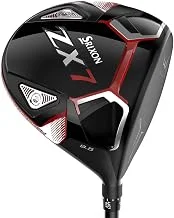
The ZX7 won the MyGolfSpy 2025 Most Wanted Players’ Irons test. One year later, the ZXi7 replaced it, and the ZX7 prices dropped accordingly.
This is a tour-proven, independently tested, objectively outstanding players’ iron available at a significant discount.
Single-piece forging with a compact blade shape, narrow topline, and minimal offset.
The Tour V.T. Sole provides versatile turf interaction, and the PureFrame design concentrates mass behind the sweet spot. It lacks the i-FORGED process of the ZXi7, but the performance gap between generations is smaller than the marketing would suggest.
If you’re budget-conscious and willing to play “last year’s” model, which is still beating most “this year’s” models, the ZX7 is the smartest purchase on this list.
| Pros | Cons |
|---|---|
|
|
Scroll to see more features
Top 15 Golf Irons Comparison
| Iron | Price | 7i Loft | Construction | MGS 2026 Score | Best For | Buy |
|---|---|---|---|---|---|---|
| Titleist T150 | $1,500 | 32° | Forged dual-cavity | 9.0 (#1) | Best overall | Check Amazon Price |
| Srixon ZXi7 | $1,400 | 33° | Single-piece forged | 8.9 (#4) | All-around balance | Check Amazon Price |
| Wilson Staff Model XB | $1,100 | 30° | Forged hollow-body | 8.8 (#5) | Value accuracy | Check Amazon Price |
| Callaway Apex Ai 150 | $1,650 | 30° | Forged hollow-body | 8.5 (#8) | Maximum distance | Check Amazon Price |
| PXG 0311T GEN 8 | $1,600 | 31° | 5X forged hollow | 8.2 (#12) | Custom fitting | Check Amazon Price |
| Wilson Staff Model CB | $1,000 | 34° | Forged cavity-back | 8.2 (#11) | Traditional feel | Check Amazon Price |
| Titleist T100 | $1,500 | 33° | Forged dual-cavity | 8.1 (#13) | Tour standard | Check Amazon Price |
| TaylorMade P770 | $1,400 | 31° | Forged hollow-body | Not tested | TM ecosystem | Check Amazon Price |
| Mizuno Pro 245 | $1,400 | 30° | GFF hollow chromoly | Not tested | Best feel | Check Amazon Price |
| Mizuno Pro 241 | $1,300 | 34° | One-piece GFF | Not tested | Pure ball striking | Check Amazon Price |
| TaylorMade P7MC | $1,300 | 33° | Compact grain forged | Not tested | Blade-like control | Check Amazon Price |
| Cobra Forged Tec X | $1,100 | 28° | Forged hollow-body | Not tested | Forgiveness transition | Check Amazon Price |
| Cobra KING Tec | $1,200 | 30° | 5-step forged hollow | Not tested | Modern players' iron | Check Amazon Price |
| TaylorMade P790 | $1,500 | 30° | Forged hollow-body | Not tested | Distance + looks | Check Amazon Price |
| Srixon ZX7 | $800-1,000 | 33° | Single-piece forged | 2025 winner | Budget performance | Check Amazon Price |
Scroll to see more features
Frequently Asked Questions
What is the best players’ iron for 2026?
Based on independent testing data from MyGolfSpy’s 260-hour, 14,400-shot evaluation, the Titleist T150 is the best overall players’ iron of 2026.
It posted the highest combined scores for distance, forgiveness, and accuracy. The Srixon ZXi7 is the most balanced across all categories.
What’s the difference between a player’s iron and a player’s distance iron?
Players’ irons prioritize control, workability, and traditional loft packages.
For mid-handicappers who find players’ irons punishing in the long irons, replacing the 3- and 4-iron with a hybrid is a legitimate move. See my best golf hybrid club guide for the options.
Players’ distance irons use hollow-body construction, stronger lofts, and face technology to add distance and forgiveness while maintaining a compact look.
The line between the two categories is increasingly blurred; irons like the Titleist T150 and TaylorMade P770 sit right on the boundary.
Why weren’t Mizuno, Cobra, and TaylorMade in the MyGolfSpy test?
MyGolfSpy acknowledged that the 2026 cohort was limited to 15 models.
They noted that TaylorMade, Sub 70, New Level, and Cobra remain excellent options that weren’t included. No specific reason was given for each omission.
This is why cross-referencing multiple independent reviews matters.
Are more expensive irons actually better?
Not necessarily. The Wilson Staff Model XB at $1,100 outperformed several irons costing $1,400-$1,650 in accuracy.
The previous-generation Srixon ZX7 at $800-1,000 won the entire 2025 test.
Price correlates with materials and manufacturing methods, but performance depends on how well the iron fits your swing.
Should I buy players’ irons as a mid-handicapper?
It depends on your priorities.
At the other end of the bag, your driver choice sets the ceiling on your tee game. I reviewed the best golf drivers to buy: 9 drivers from $100 to $699 organized by the problem each one solves.
If you’re a 10-15 handicap with consistent ball-striking and you value shot-shaping and feedback, a more forgiving players’ iron like the T150 or Wilson XB could work.
If you’re still working on contact consistency, players’ distance or game improvement irons will help your scores more.
How important is the shaft in a player’s iron?
Critically important. The shaft affects launch angle, spin rate, trajectory, and feel.
Most players’ irons ship with premium steel shafts (Dynamic Gold, KBS Tour, Project X), but the right shaft weight and flex for your swing speed and tempo can make a bigger performance difference than the iron head itself.
Can I mix and match irons from different sets?
Yes, and many competitive golfers do. Common combo setups include a more forgiving iron in the long irons (3-5) with a traditional players’ iron in the mid and short irons (6-PW).
Your iron set determines your wedge gapping too. I ranked the best golf wedges for scoring: 5 wedges on accuracy, spin, and wet performance to help you build the scoring end of the bag.
Titleist’s T-Series, TaylorMade’s P-Series, and Mizuno’s Pro line are all designed for seamless blending within their families.
What does “forged” actually mean in golf irons?
Forging starts with a solid billet of metal (usually carbon steel) that’s heated and pressed into shape under extreme pressure.
This compresses the grain structure and produces a softer feel at impact compared to cast irons.
Most players’ irons are forged because better players prioritize feel and feedback.
Why do some players’ irons cost $1,600+ while others cost $800?
Price is driven by materials (tungsten, maraging steel, chromoly), manufacturing complexity (multi-step forging, CNC milling), R&D investment (AI-designed faces, proprietary polymers), and brand positioning.
Whether that premium translates to better performance for your game depends entirely on fitting.
