

Pick up any iron from a pro shop rack, and you are holding the result of one of two fundamentally different manufacturing philosophies.
One starts with a solid block of steel and hammers it into shape. The other melts metal and pours it into a mold.
Both produce functional golf clubs, but what happens inside the metal during each process determines everything from how the club feels in your hands to how much your fitter can adjust it after purchase.
I researched this by reviewing technical documentation from major OEMs, metallurgical references, and independent reports from GolfWRX and MyGolfSpy.
Here is what actually happens on the factory floor and why it matters to the iron sitting in your bag.
The Forging Process
(For Illustrative Purposes Only)
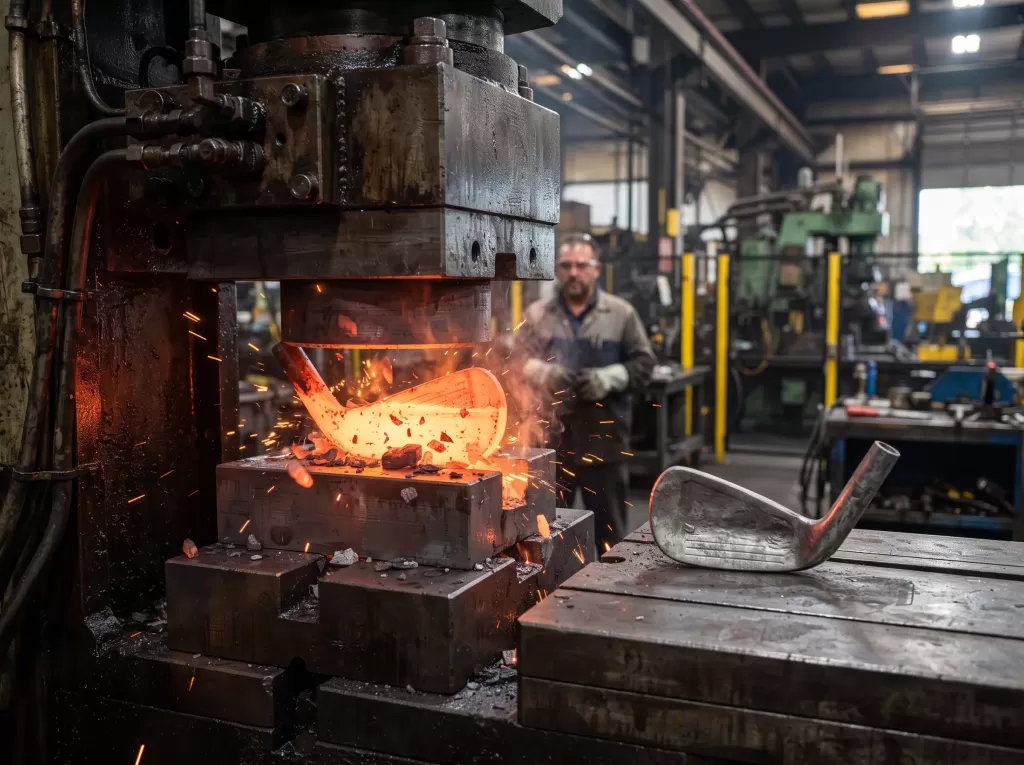
Forged iron begins life as a solid billet of carbon steel. The specific grade of steel varies by manufacturer and is a bigger factor in performance than most golfers realize.
The most common grades are 1025 carbon steel (used across much of the industry), 8620 carbon steel (favoured by several Cobra and Srixon models for its balance of softness and strength), and Mizuno’s proprietary S20C, which is softer and purer than standard alternatives.
S20C is the reason Mizuno forged irons have a distinct feel that other manufacturers have struggled to replicate for decades.
The billet is heated to roughly 1,200°C until it becomes malleable, then placed between precision dies and pressed or stamped under extreme force.
This is not a single hit. Depending on the head design, the billet may go through three to five stamping stages, each progressively refining the shape toward the final product.
What this process creates inside the metal is a uniform grain structure. The steel’s internal crystalline grain flows in a consistent, aligned direction, which is what produces that cohesive, responsive sensation at impact.
When you strike a forged iron cleanly, the vibration travels through a dense, uniform internal structure and reaches your hands with minimal signal loss. That is the physics behind “feel.”
After forging, the head goes through CNC milling for precision on the face, sole, and topline. This finishing step is what delivers the tight tolerances that better players expect from a forged iron.
The constraint of forging is a design limitation. Because you are shaping a single piece of solid metal, there are limits to how much mass you can redistribute.
Internal cavities, channels, and extreme perimeter weighting configurations that cast irons achieve easily are difficult or impossible to replicate through forging alone.
The Casting Process
(For Illustrative Purposes Only)
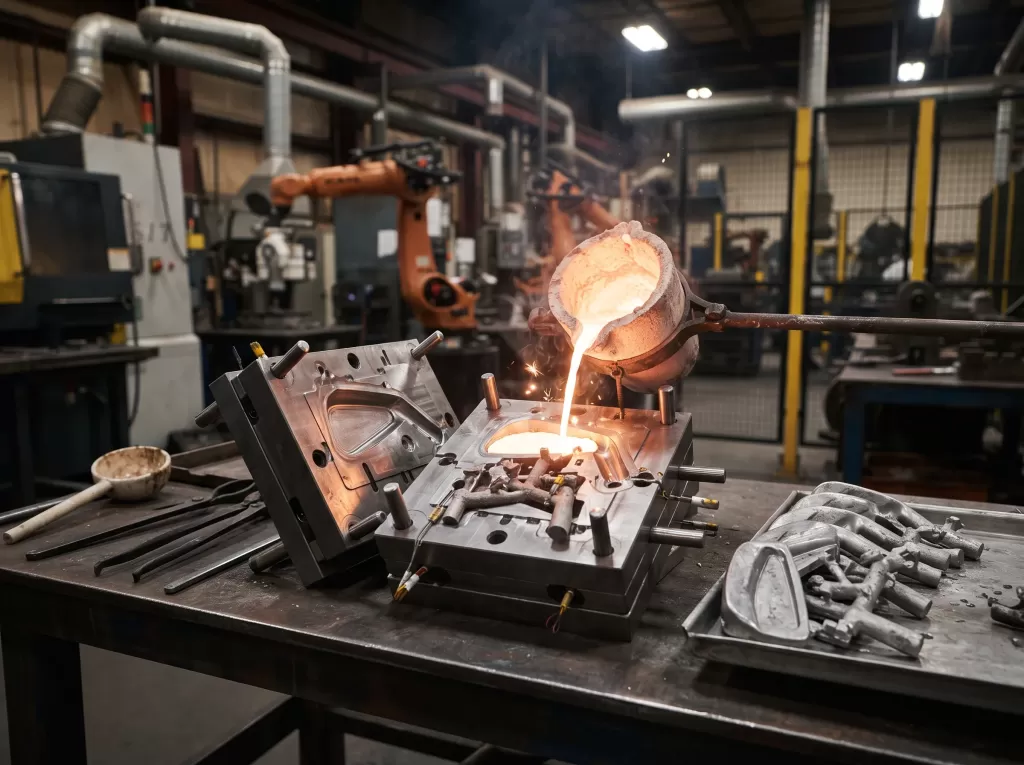
Cast irons use a method called investment casting, sometimes known as the lost-wax process. It is an ancient technique (jewellers and weapons makers used it for centuries) adapted for modern precision manufacturing.
The process starts with a wax replica of the clubhead, crafted to exact specifications. That wax model is coated in layers of ceramic slurry, building up a hard shell around it. Once the ceramic hardens, the assembly goes into an oven where the wax melts and drains out, leaving a hollow ceramic mold in the exact shape of the intended clubhead.
Molten metal is then poured into this mold. The most common alloys for cast irons are 17-4 PH stainless steel (precipitation-hardened, strong, and corrosion-resistant) and 431 stainless steel.
These are harder than the carbon steels used in forging, which contributes to the firmer feel at impact but also to the superior durability and groove longevity of cast irons.
After cooling, the ceramic shell is broken away, and the raw head goes through finishing: grinding, polishing, and quality inspection.
The critical advantage of casting is design freedom. Because you are pouring liquid metal into a mold, manufacturers can engineer undercut cavities, internal speed channels, tungsten weighting pockets in precise locations, and multi-material constructions that would be physically impossible to forge from a single billet.
This is why the vast majority of game improvement irons, players’ distance irons, and high-MOI designs use casting. The process lets engineers put mass exactly where the physics says it should go.
Where the Line Gets Blurred: Hybrid Construction
(For Illustrative Purposes Only)
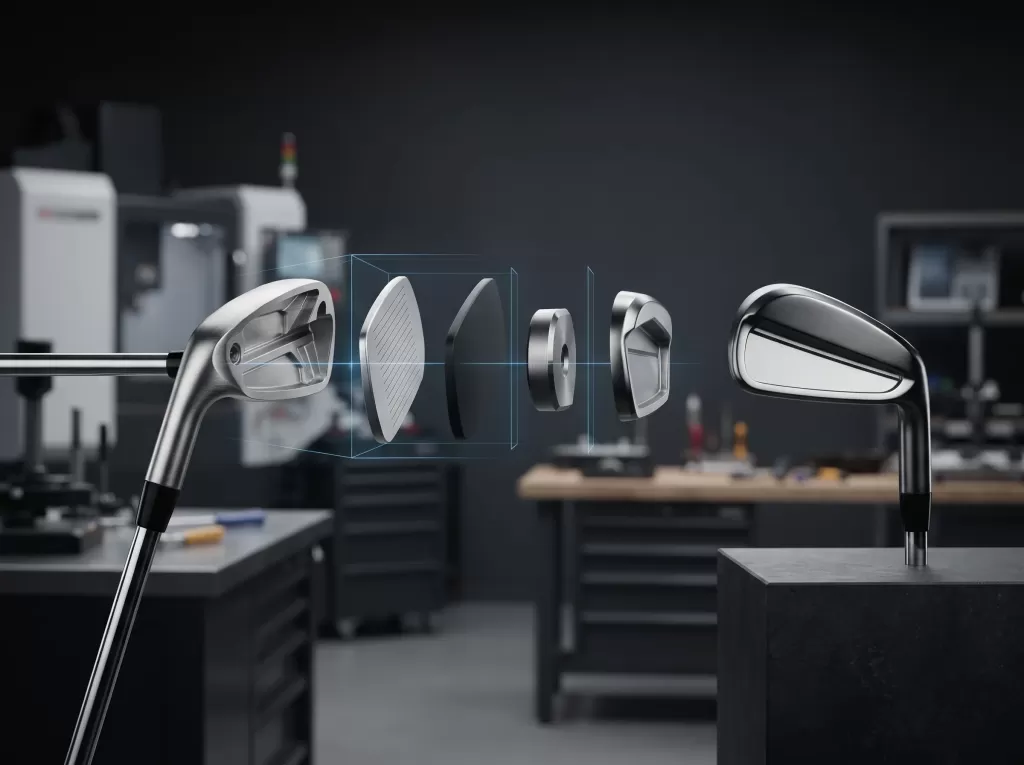
Here is where the industry has moved beyond the simple “forged or cast” binary, and where most comparison articles fall behind the reality of what is actually on the market.
The Titleist T200 uses a cast body with a forged L-face insert. The body provides the structural design flexibility of casting (perimeter weighting, tungsten placement), while the forged face delivers the energy transfer characteristics and feel of forged carbon steel. Two manufacturing methods in one clubhead.
The TaylorMade P770 is a forged body with internal tungsten speed pockets and speed foam injection. It starts as a forged piece of carbon steel but incorporates elements (internal dampening, strategic weighting) that were historically only possible in cast designs.
This is why the vast majority of game improvement irons, players’ distance irons, and high-MOI designs use casting.
Callaway’s Apex line is forged from 1025 carbon steel but uses an AI-designed face pattern optimized through machine learning.
The face thickness varies across micro-zones in ways that would have been unthinkable in traditional forging just five years ago.
PING’s Blueprint series takes yet another approach: a compact forged blade with tungsten toe weighting precision-placed through a secondary process after the initial forging.
These hybrid constructions are not edge cases. They represent a growing share of the iron market, particularly in the player’s distance and better player categories.
Treating “forged” and “cast” as two neat, separate boxes no longer reflects what manufacturers are actually building.
Why the Manufacturing Method Matters to You
(For Illustrative Purposes Only)
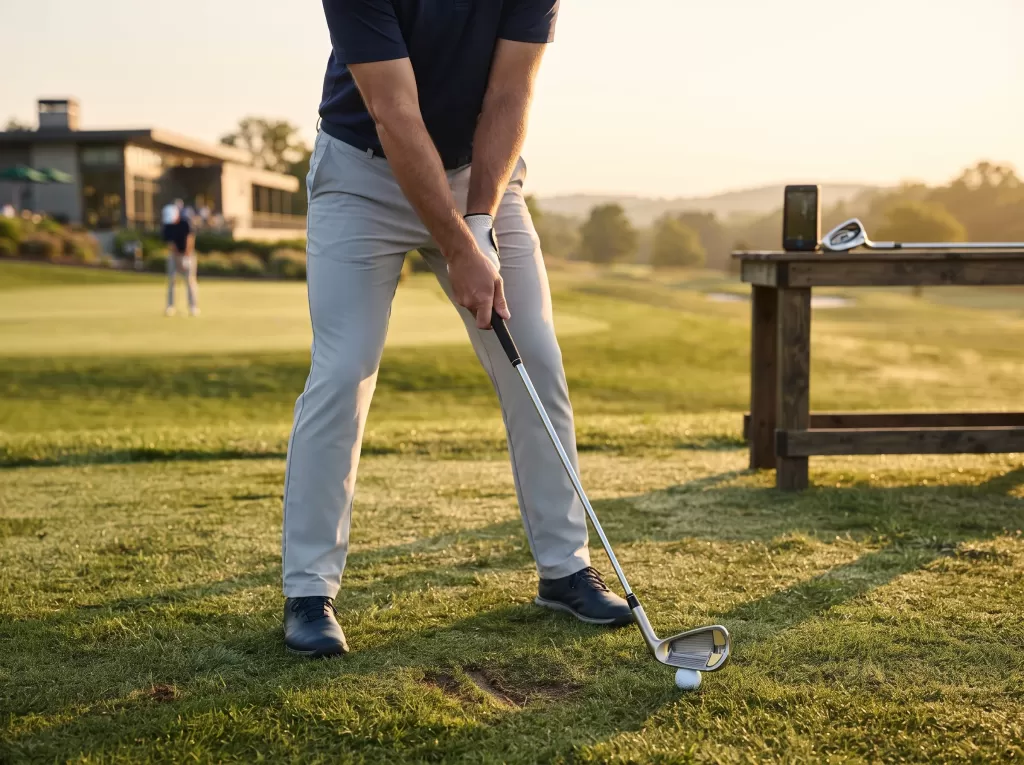
Understanding how your irons were made is not academic trivia. It has direct implications for three things that affect your game and your wallet.
Understanding how your irons were made isn’t academic trivia, it directly shapes what you should look for in our complete irons buyer’s guide.
Fitting adjustability
Forged carbon steel bends 2 to 4 degrees safely for loft and lie adjustments. Cast stainless tolerates roughly 1 degree. If your fitting requires significant adjustments, the construction method of your irons determines whether your fitter can deliver the specs your swing needs.
Durability and groove life
Softer forged carbon steel wears faster. Harder cast stainless holds groove geometry longer. Your replacement cycle and annual cost of ownership are directly tied to this material difference.
Feel and give feedback.
The grain structure created during forging transmits impact information differently from the crystalline structure of a cast head. If feedback precision matters to your shot-making process, this is not a subjective preference. It is a measurable difference in how vibration travels through the metal.
For the full breakdown of which type you should actually play based on your handicap, budget, and fitting needs, I cover the decision framework in a dedicated comparison.
For the full breakdown of which type you should actually play based on your handicap, budget, and fitting needs, see the forged vs. cast irons comparison.
Forged vs. Cast Irons: Manufacturing Process
Reading about the process is one thing; seeing it happen is another.
This video walks through both manufacturing methods in action, from a solid steel billet being hammered into a forged iron to molten metal being poured into a ceramic mold for casting.
It’s a good visual companion if you want to see exactly where that “feel” difference actually comes from.
Frequently Asked Questions
Do forged irons go farther than cast irons?
Not inherently. Distance is driven by loft, ball speed, and launch angle. Modern cast irons often appear longer because of loft creep. At equal loft, robot testing shows negligible distance differences between the two construction types.
Can you bend cast iron for a fitting?
Yes, but only about 1 degree safely. Forged irons tolerate 2 to 4 degrees of loft and lie adjustment, giving fitters significantly more room to customize the club to your swing.
How long do forged irons last?
With regular play (80 to 100 rounds per year), forged grooves maintain performance for roughly 3 to 4 years. Cast stainless holds up for 5 to 6 years under the same usage pattern.
Are forged irons worth the extra cost?
They are if you have the strike consistency to use the feedback, and you need the fitting flexibility that forged steel provides. If forgiveness and value are higher priorities, cast irons deliver more for the money.
What is a combo iron set?
A combo set blends two different iron models, typically forged short irons for feel and cast long irons for forgiveness. Over half of touring professionals use some version of this approach. It is worth exploring with your fitter if you are a mid-handicapper or better.
How are forged and cast irons actually manufactured?
The manufacturing processes differ significantly in materials, tooling, and what each method allows designers to achieve. I cover the full breakdown, including steel grades and hybrid construction, in a separate deep dive.