
Buying your first golf clubs is exciting until you realize there are forty different options and every website ranks them in a different order.
I went through that confusion myself. One reviewer loved a set that another called mediocre. Brands I’d never heard of were showing up alongside Callaway and TaylorMade. Forum posts contradicted buying guides, and most of what I read felt like it was written for someone who already understood golf equipment.
So I’m going to do this differently. This guide ranks specific sets, irons, and brands based on what actually matters for new golfers: forgiveness on mishits, ease of launch, comfortable weight, and whether the equipment helps you improve rather than punishes you for not being good yet.
I’m not pretending I put every set through a robot test. What I did was research across every major equipment publication MyGolfSpy, Golf Monthly, Today’s Golfer, Independent Golf Reviews, and GolfWRX compared their test results, noted where they agreed and disagreed, and filtered everything through one hard requirement: the product has to be available on Amazon with real user reviews. No direct-to-consumer-only brands that you can’t easily return.
If you want to understand what makes a golf club beginner-friendly before looking at product picks, start with my companion guide on how to choose golf clubs as a beginner.
Best Beginner Golf Club Sets

(For Illustrative Purposes Only)
Complete sets remain the smartest first purchase for most new golfers.
Once you’ve found the right beginner set, explore USAGolfGuy for more golf club reviews, equipment recommendations, and buying guides to help build the rest of your bag.
You get matched shafts, engineered loft gaps, and a ready-to-play bag at a per-club price that individual purchasing cannot match.
Best Overall Starter Set | Forgiveness Meets Value
The Callaway Strata Plus and Callaway Edge sit at the top of this category for a reason that goes beyond brand recognition.
They’re designed as complete systems: driver, fairway wood, hybrid, irons, wedge, putter, and bag, where every component is built to work together.
The Strata Plus runs around $400 to $550 depending on the piece count. The Edge pushes closer to $600 but includes better face technology, a more refined putter, and clubs that hold up as your ability develops.
What I noticed when comparing these to other sets at the same price was the iron performance. Callaway’s cavity-back design in both models retains more ball speed on toe and heel strikes than competitors in this price bracket.
That translates directly to confidence; your mistakes lose less distance, which keeps you engaged instead of frustrated.
The woods launch well for moderate swing speeds. The bag quality is decent, not exceptional.
The putter is functional, though I’d argue most beginners should consider upgrading to a proper mallet putter once they start caring about their short game.
If you’re a first-time golfer and you want one purchase that covers the entire course, the Edge is worth the step up from the Strata Plus.
If you’re testing whether golf will stick, the Strata Plus is honest equipment at a fair price.
Best Budget Set Under $350

(For Illustrative Purposes Only)
Top Flite XL and Wilson SGI compete at the entry point, where the real question is, “Will I play enough to justify spending more?”
Top Flite builds sets for golfers who want functional equipment without a significant financial commitment. The XL provides a full bag with forgiving-enough irons, a usable driver, and a setup that covers every shot type.
Materials are simpler; the bag is basic, the finishing isn’t polished, and the shafts don’t have the same consistency you’d find in a Callaway set.
But for someone playing monthly or figuring out whether they enjoy the game, those compromises rarely affect actual performance on the course.
Wilson’s SGI line is a step above Top Flite in feel and finishing. The irons have slightly wider soles that help with turf interaction, and the overall build quality feels like it could survive more than a couple of seasons.
These sets cut corners in places that experienced golfers would notice. A first-time player probably won’t.
Best Premium Set For Beginners

(For Illustrative Purposes Only)
When someone tells me they’ve already booked ten rounds and want clubs they won’t outgrow in three months, I point them toward the Callaway XR 26 package set or the Cobra Fly-XL Complete.
The Callaway XR 26 lands at the top of the premium beginner range. Every review source I checked Golf Monthly, Today’s Golfer, and Golfmagic flagged the iron and wood performance as a genuine step above typical boxed sets.
The face technology produces faster ball speeds, the woods launch cleanly for moderate swing speeds, and the included Odyssey putter is a properly designed putting instrument rather than an afterthought.
The Cobra Fly-XL earns its place because Cobra consistently undercuts competitors on price while delivering comparable forgiveness. The AIR-X technology keeps the set lightweight, and Cobra’s irons tend to produce a slightly higher ball flight than Callaway’s at similar lofts. For a slower-swinging beginner, that extra height can mean the difference between reaching a green and falling short.
These sets run $600 to $900.
That’s more money upfront, but the equipment should last through your first two to three years of playing without needing replacement. Across that time horizon, the per-round cost is actually lower than buying a budget set and replacing it within a year.
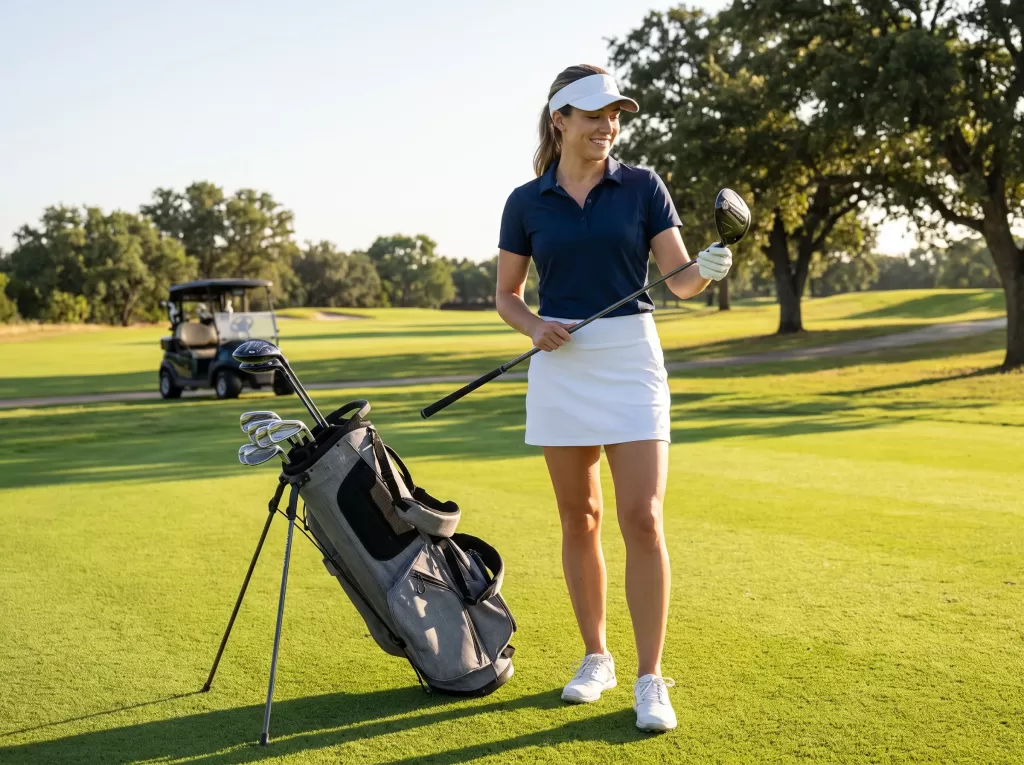
Best Beginner Golf Clubs for Women
(For Illustrative Purposes Only)
One of the most common misunderstandings I’ve encountered is that women’s beginner golf clubs are just shorter, lighter versions of men’s equipment.
The engineering is actually more considered than that.
A well-designed women’s set adjusts swing weight balance, grip diameter, and shaft flex profiles tuned for swing speeds that typically fall between 55 and 80 mph.
Those changes affect launch angle, carry distance, and how the club feels through impact.
Why Women's Sets Are More Than Shorter Men's Clubs
Grip size matters more than most people realize. A grip that’s too large forces the hands open, which can create a slice.
Women’s grips are typically narrower, allowing a more natural hand position through the swing.
Shaft flex in women’s sets is generally softer: L flex, or A flex, which helps load the shaft and generate speed without requiring an aggressive swing.
This isn’t about making the club “easier” in some general sense. It’s about matching the engineering to the swing characteristics of the person using it.
Weight distribution shifts as well. Women’s sets typically move more weight lower and deeper in the clubhead, helping launch the ball higher from moderate swing speeds.
For a new player who doesn’t yet generate a lot of power through impact, that structural difference shows up immediately on the course.
Callaway REVA, Strata Women's, and XXIO
The Callaway REVA is designed around helping golfers generate launch and distance without needing fast swing speeds.
The lightweight construction and forgiving clubfaces make it a strong pick for beginners who want premium equipment they can grow into.
The Strata Women’s set provides a complete beginner setup with matched clubs at a lower price point. For someone who wants simplicity and value without researching individual components, it covers the course.
XXIO goes further on lightweight engineering than any other manufacturer in this space. Their women’s sets suit players who want help generating speed without forcing the swing.
The price point is higher: XXIO positions itself as a premium option, but the technology is genuinely different, not just cosmetically repackaged.
My recommendation: choose based on how the clubs feel and perform, not based on how they’re marketed.
Best Starter Golf Clubs for Men

(For Illustrative Purposes Only)
When new golfers ask me about men’s starter sets, they usually start with a brand name. I usually start with two questions instead.
How tall are you? And have you ever measured your swing speed?
Those answers matter more than the logo on the clubhead.
A golfer over 6’1″ may need clubs that are an inch longer than standard. Someone under 5’7″ might benefit from shorter shafts that improve contact consistency.
A faster-swinging beginner in their twenties might outgrow regular-flex shafts within a season, while someone with a smoother tempo would be fine with them for years.
What to Prioritise When Comparing Men's Beginner Sets
Forgiveness should still be the first filter. After that, shaft flex and club length are the two variables that create the biggest difference between sets that feel right and sets that feel like a constant struggle.
Strong options in this space include the Callaway Strata, Callaway Edge, Cobra Fly-XL, and Wilson Profile SGI.
All four build around cavity-back forgiveness and lightweight construction. The differences show up in materials, putter quality, bag durability, and how well the clubs transition as the golfer improves.
The mistake I see most often is beginners choosing clubs because they look professional rather than because they match the golfer’s body and ability.
A sleek iron that requires center-face contact to perform is not helping you learn. A wider-soled, offset iron that keeps your mishits playable.
Best Left-Handed Beginner Sets

(For Illustrative Purposes Only)
Left-handed golfers face a genuinely frustrating situation. Fewer brands produce left-handed beginner sets, and the ones that do often limit the configurations available.
Callaway, Cobra, Wilson, and TaylorMade are the most consistent providers of left-handed complete sets. Ping offers left-handed options in their iron lines but doesn’t sell a full beginner package.
If the specific model you want doesn’t come in left-handed, building a used bag from individual clubs is a solid alternative.
The used market has better left-handed inventory than most people expect because left-handed trade-ins tend to sit longer on resale shelves, which sometimes means better prices.
Regardless of the route, a left-handed golfer still needs the same forgiveness, shaft match, and feel as any other beginner. Don’t settle for whatever’s available just because options are thinner.
Best Beginner Irons

(For Illustrative Purposes Only)
I was obsessed with finding the right driver when I started playing. I thought longer tee shots would fix my scores.
They didn’t. Most of my strokes happened with irons. Once I understood that, I started paying more attention to the clubs I was actually swinging twelve to fifteen times per round.
For golfers who want better irons than what comes in a complete set or who are building their bag category by category, standalone iron sets are where the real performance gains live.
If you’re ready to move beyond a starter set, my guide to the best golf irons breaks down the leading options by performance, forgiveness, and value.
Cavity-Back vs. Hollow-Body vs. Hybrid-Style Irons
Not all beginner irons work the same way. Understanding the three main construction types helps you match the iron to your specific weakness.
Cavity-back irons are the standard in beginner equipment. Weight distributed around the clubhead perimeter creates stability on mishits.
They’re suitable for most new golfers and remain playable as skill improves. If you have no idea what you need, start here.
Hollow-body irons borrow technology from metalwoods. The hollow interior allows manufacturers to add internal weighting, producing higher launch and more consistent distance.
These are a step up from basic cavity-backs for players who struggle with distance.
Hybrid-style irons take forgiveness to its maximum. The wider sole and larger profile look different from traditional irons, but they get the ball airborne easier than anything else.
If you consistently struggle to launch iron shots, these can change your experience on the course overnight.
Most Forgiving Iron Sets for High Handicappers in 2026

(For Illustrative Purposes Only)
Rather than just listing names, I want to explain what makes each of these particularly suited to new golfers with developing swings.
Ping G440 irons have been the forgiveness benchmark for multiple model cycles. The perimeter weighting is aggressive, the sole is wide enough to prevent digging, and they launch high without ballooning.
Ping designed these for golfers who don’t consistently hit the center, which describes every beginner I’ve met.
The Cleveland Launcher XL Halo uses hybrid-style construction throughout the set. The long irons in particular perform unlike traditional irons; they launch like a hybrid because structurally, they practically are one.
For beginners who’ve struggled with anything below a 7-iron, this set can genuinely change what those clubs feel like.
Callaway Elyte X focuses on speed and distance retention across the face. When you miss the sweet spot, these irons lose less ball speed than most competitors. For a beginner whose contact point wanders shot to shot, that consistency shows up on the scorecard.
The TaylorMade Qi35 Max builds stability into a head that still looks like a traditional iron. The visual appearance is less intimidating than full hybrid-style designs, which matters for golfers who want forgiveness without the oversized aesthetic.
Cobra King MAX uses weaker lofts than the standard Cobra King iron, which means more launch from the same swing. The larger footprint adds heel-to-toe stability. If getting long irons airborne has been a persistent problem, this is one of the easiest iron sets on the market to hit.
Easiest Irons to Hit for Golfers Who Struggle With Launch

(For Illustrative Purposes Only)
Launch height is the clearest separator between an iron that helps a beginner and one that punishes them.
If your iron shots consistently fly low and run past the target, or worse, never get high enough to carry hazards, the club isn’t matching your swing.
The irons that produce the highest launch at moderate swing speeds in 2026 tend to share a few traits: deep center of gravity, wide sole, and internal weighting positioned low in the clubhead.
The Cleveland Launcher XL Halo, Cobra King MAX, and Callaway Rogue ST Max OS are the strongest performers on this specific criterion.
Cobra, TaylorMade, and Cleveland

(For Illustrative Purposes Only)
Cobra consistently delivers value. The Fly-XL and AIR-X lines provide lightweight construction and easy launch at prices that undercut Callaway’s premium sets. If I were ranking purely on value for money, Cobra would be at the top.
TaylorMade brings aggressive face technology into beginner equipment. Their complete sets aren’t as widely available as Callaway’s, but their iron lines, particularly the Qi range, are strong options for beginners buying irons separately.
Cleveland focuses on the “maximum forgiveness” end of the spectrum. Their Launcher XL Halo line is designed specifically for golfers who need as much help as possible getting the ball airborne.
Less fashionable than Callaway or TaylorMade, arguably more functional for high-handicappers.
Top Flite, Wilson, and Stix: The Budget Tier Ranked Honestly
Top Flite wins on price. Their sets regularly land under $300 and provide enough forgiveness to learn the basics. Materials and finishing are noticeably simpler, and the included bags tend to wear faster.
Wilson’s SGI series is the better product at a slightly higher price: better iron feel, wider soles, and a more refined overall design.
Stix operates as a direct-to-consumer brand with clean aesthetics and decent engineering. Their clubs look more premium than their price suggests.
The tradeoff is limited retail availability and a smaller resale market.
Are Titleist or Ping Worth It for Beginners?

(For Illustrative Purposes Only)
Titleist doesn’t manufacture a beginner complete set. Their entry point is individual iron sets like the T350, which is beginner-viable but priced for golfers who’ve already committed to the game. I wouldn’t recommend Titleist as a starting point.
Ping is different. They don’t sell complete boxed sets either, but their iron lines, particularly the G440, are arguably the most forgiving irons available at any skill level.
A beginner who buys Ping G440 irons as their first standalone iron set is buying equipment they could realistically play for five or more years.
The question with both brands is whether a new golfer should spend premium iron money before their swing stabilizes. For most beginners, the answer is no.
For someone who knows they’ll play long-term and wants to skip the “buy cheap, replace soon” cycle, it’s worth considering.
Beginner Golf Club Distances

(For Illustrative Purposes Only)
I made the mistake of comparing my distances with what I saw on tour broadcasts.
Tiger Woods hitting a 7-iron 185 yards has nothing to do with what a beginner’s 7-iron should travel.
Setting realistic expectations prevents frustration and helps you make better decisions on the course.
Average Distances by Club
These are approximate distances for a typical male beginner with moderate swing speed:
Driver: 180 to 220 yards.
Fairway wood: 160 to 190 yards.
Hybrid: 140 to 180 yards.
6-iron: 130 to 155 yards.
7-iron: 145 to 180 yards.
8-iron: 110 to 140 yards.
9-iron: 100 to 130 yards.
Pitching wedge: 90 to 140 yards.
Sand wedge: 60 to 80 yards.
Once you’re comfortable with your starter set, learning which fairway woods can help fill the distance gap between your driver and irons is the next step.
Female beginners will generally see shorter distances, typically 15 to 25 percent less, depending on swing speed and technique.
These numbers will change as your swing develops. They’re a starting point for course management, not a permanent ceiling.
Why Consistent Contact Matters More Than Raw Distance

(For Illustrative Purposes Only)
Your clubs are only part of the equation, though. Once you understand your swing speed and typical distances, choosing from the best golf balls can help you find the right balance of distance, feel, and greenside control.
A well-struck 7-iron that goes 130 yards every single time is more valuable to your score than a 7-iron that alternates between 95 and 165 depending on contact quality.
Distance improves naturally with better mechanics. Consistency comes from practice and from using equipment that matches your current ability.
The lesson I wish I’d learned sooner: stop chasing extra yards and start tracking how tight your distance spread is with each club. When that spread narrows, your scores will follow.
When Should Beginners Upgrade Their Clubs?

(For Illustrative Purposes Only)
My first set helped me learn the basics. But I eventually noticed moments when the equipment wasn’t keeping up with what my swing was trying to do.
Signs You’ve Outgrown Your Starter Set
You’re regularly breaking 100. Your swing speed has noticeably increased since you started. You’re striking the ball more consistently, with fewer fat and thin shots and more center-face contact.
You’re noticing limitations in your clubs; maybe the driver balloons too much, the irons don’t stop on greens, or the putter just doesn’t aim where you think it does.
Those are signals, not deadlines. Some golfers outgrow a starter set in six months. Others play the same equipment comfortably for years.
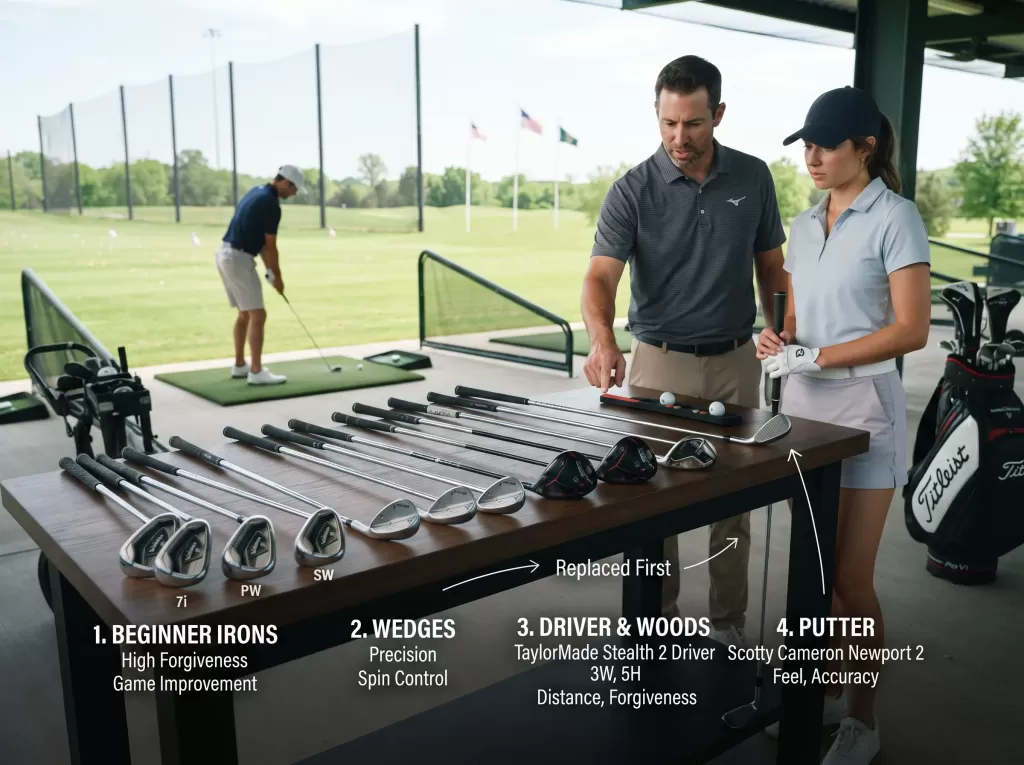
The Upgrade Path | Which Clubs to Replace First
(For Illustrative Purposes Only)
When I upgraded, I didn’t start with the driver, even though that’s what most beginners want to replace first. driver,
I started with my irons because they affect more shots per round than any other club category. Better irons changed my approach game immediately.
Wedges came next. The short game is where strokes disappear fastest once your skill develops enough to create different trajectories and spin.
Wedges came next. The short game is where strokes disappear fastest once your skill develops enough to create different trajectories and spin.
When you reach that stage, my guide to the best golf wedges can help you choose a wedge setup that matches your developing short game.
The driver came last. It’s one shot per hole on par 4s and 5s. Important, yes. But not where most of your scoring improvement happens early on.
If you’re looking at the transition from beginner to intermediate equipment, sets in the Cobra AIR-X, TaylorMade Qi, and Cleveland Launcher XL ranges are built to bridge that gap, being forgiving enough for developing golfers and refined enough to stay in the bag as handicaps drop.
Frequently Asked Questions
What are the best golf clubs for beginners in 2026?
Complete sets from Callaway (Strata Plus, Edge, XR) and Cobra (Fly-XL) consistently perform well across review sources.
For standalone irons, the Ping G440 and Cleveland Launcher XL Halo offer the most forgiveness on the market.
What’s the difference between men’s and women’s beginner golf clubs?
Beyond length, women’s sets adjust grip diameter, shaft flex, and swing weight to match swing speeds that typically fall between 55 and 80 mph.
These aren’t cosmetic changes; they affect launch angle, carry distance, and how the club feels through impact.
Can you play golf with just a 7-iron and a putter?
You can. It’s actually a good way to learn because it forces you to create different shots with the same club.
Many teaching professionals recommend starting this way before expanding your bag.
What is the most forgiving golf club for a new player?
For irons, the Ping G440 and Cleveland Launcher XL Halo are consistently the most forgiving options in independent testing.
For complete sets, the Callaway Edge retains the most performance on off-center strikes.
When should a beginner upgrade from a starter set?
When you’re regularly breaking 100, your swing is more consistent than it was when you started, and you’re noticing that your clubs, but not your technique, are limiting specific shots.
Most golfers reach that point somewhere between six months and two years.
