
I bought the wrong golf clubs when I started playing. Not because they were bad clubs; they were actually well-made. They just weren’t made for someone at my skill level.
The irons had thin faces and minimal forgiveness. The driver was stiff-shafted and built for a swing speed I didn’t have.
The whole bag looked great sitting in my garage, which is where it spent most of its time because I kept getting frustrated on the course.
My second set cost less than half the price. It was lighter. The irons had wider soles and bigger sweet spots.
Nothing about it would have impressed a scratch golfer. But within a few weeks, I was hitting shots that actually felt like progress.
That experience taught me something I tell every new golfer now: choosing beginner golf equipment is not about buying what looks impressive.
It’s about buying what matches where your game actually is.
Your swing will change constantly during your first year. Your contact will improve. Your distances will shift.
The equipment you start with should support that process rather than fight against it.
This guide covers everything I had to learn through trial and error: what separates beginner-friendly clubs from the rest, how many you actually need, whether to buy a complete set or build your own bag, which shaft material makes sense, and the mistakes that cost me both money and confidence.
If you want specific product recommendations after reading this, I rank the actual sets and irons worth buying in my companion guide on the best golf clubs for beginners in 2026.
If you want specific product recommendations after reading this, I rank the actual sets and irons worth buying in my companion guide on the best golf clubs for beginners.
What Makes a Golf Club Beginner-Friendly

(For Illustrative Purposes Only)
I made the same mistake most new golfers make. I focused on how clubs looked instead of how they performed.
Sleek designs. Professional-looking blades. Equipment that reminded me of what I saw on broadcast coverage.
It took me a while to understand that beginner equipment should solve beginner problems, and looking like a tour player’s bag isn’t one of those problems.
A beginner-friendly golf club is designed around a straightforward idea: help a developing golfer get better results while they’re still learning.
New golfers rarely strike the center of the clubface consistently. Swing path wanders. Timing is still developing.
Distance control builds through repetition and practice.
The right equipment reduces the penalty from those inconsistencies. The wrong equipment magnifies them.
Forgiveness, Launch, and Offset | The Three Traits
I didn’t understand forgiveness until I switched to my second set of irons. Before that, I assumed every poor shot was entirely my fault.
And while improving your swing is always the priority, the club itself influences how much a mistake costs you.
Forgiveness describes how well a club performs when the strike isn’t centered. For beginners, off-center contact happens constantly. One shot connects solidly; the next catches the heel.
Forgiving golf clubs reduce the damage from those mishits. Most beginner irons use a cavity-back design, with weight distributed around the perimeter of the clubhead rather than concentrated behind the center.
This creates more stability and a larger effective hitting zone.
I noticed the difference immediately. A poor strike was no longer an automatic disaster. The ball still traveled a reasonable distance and stayed roughly on line.
That kept my confidence from draining away mid-round.
Launch was the second thing I learned to value. Getting the ball into the air was one of my biggest early struggles.
Experienced players hit iron shots that climbed high and landed softly while mine stayed low and ran past everything.
The problem wasn’t effort. I didn’t have the consistent contact required for demanding clubs.
Beginner clubs usually feature a lower and deeper center of gravity. That design helps launch the ball higher without needing a textbook strike.
This matters with irons, hybrids, and fairway woods basically every club where launch angle determines whether a shot reaches the green or falls short.
Offset is the third trait worth understanding. It’s designed to help with the slice, which was the first real problem I had to deal with.
The clubface sits slightly behind the hosel, giving the golfer a fraction more time to square the face through impact. It’s not a cure. But in early rounds, it can make the difference between “playable” and “lost in the trees.”
Many forgiving irons for beginners include an offset for exactly that reason.
Why Lightweight Construction Changes Everything

(For Illustrative Purposes Only)
I wish someone had explained club weight to me earlier. I assumed heavier meant more powerful. I thought a heavier club would naturally produce more distance.
Instead, I worked harder, tired faster, and lost consistency by the back nine.
A club that’s too heavy makes it difficult for beginners to create reliable speed and rhythm. Most new golfers have moderate swing speeds, especially while learning proper mechanics.
Lighter designs let them generate speed more naturally without fighting the equipment.
Graphite shafts are part of this equation; they weigh less than steel and can help with swing speed, fatigue, and overall comfort. I’ll get into shafts specifically later in this guide.
The biggest improvement I noticed came when I stopped trying to overpower the club and started using equipment that matched my natural movement.
But lighter isn’t automatically better for everyone. A golfer with naturally high swing speed might feel like an ultralight club is whippy and imprecise. The goal is always matching the equipment to the player.
Features Beginners Should Ignore

(For Illustrative Purposes Only)
Golf marketing can convince beginners they need every feature available. I know because I fell for it.
Adjustable drivers sounded exciting. Blade irons looked professional. Advanced technology sounded like an instant upgrade.
Most of these features are designed for players who already understand their swing.
Adjustable hosels let experienced golfers fine-tune ball flight. For a beginner who changes swing path every few shots, constantly tweaking settings creates confusion rather than improvement.
Low-spin drivers target players with fast swing speeds who already create excessive spin. Many beginners have the opposite problem: they need help generating launch and carry distance.
A low-spin head can actually make a beginner’s shots fall out of the sky faster.
And blade irons I loved how they looked. They reminded me of tour equipment. But blades demand center-face contact on nearly every shot.
For most beginners, they produce less distance, lower launch, and more punishment on mishits.
The right beginner golf clubs aren’t the ones that look advanced. They’re the ones that help you get better without making the learning process miserable.
How Many Clubs Does a Beginner Actually Need?

(For Illustrative Purposes Only)
When I opened my first golf bag, I felt slightly overwhelmed. Driver, fairway wood, hybrids, irons, wedges, and a reliable putter for consistent putting performance were all sitting there, waiting for me to understand what each one was supposed to do.
I believed having more clubs would make me a better golfer. It didn’t.
The more I played, the more I realized that beginners don’t need a bag full of options.
They need a small group of reliable clubs they understand and can use with confidence.
A golfer who knows exactly how far their 7-iron carries will almost always score better than someone hauling fourteen clubs and guessing on every shot.
The USGA 14-Club Rule, And Why You Shouldn't Fill Every Slot Yet
The USGA allows a maximum of 14 clubs during a round under Rule 4.1b. That’s a ceiling, not a shopping list.
When I started, an empty slot in my bag felt like something was missing. I thought serious golfers maxed out the count.
But beginners face a different reality. Their challenge isn’t having enough options: it’s learning how far each club goes, how their swing feels different between clubs, and which clubs they actually trust when it counts.
Too many choices can slow down improvement. I’ve seen new golfers stand over a shot and spend thirty seconds deciding between three clubs they can’t meaningfully distinguish. That indecision creeps into the swing.
Starting with around 8 to 10 clubs keeps decision-making simple. You learn your distances faster.
You develop consistency with the clubs you’re actually using. A smaller bag doesn’t limit improvement; it usually accelerates it.
The Minimum Bag Setup That Covers Every Shot on the Course
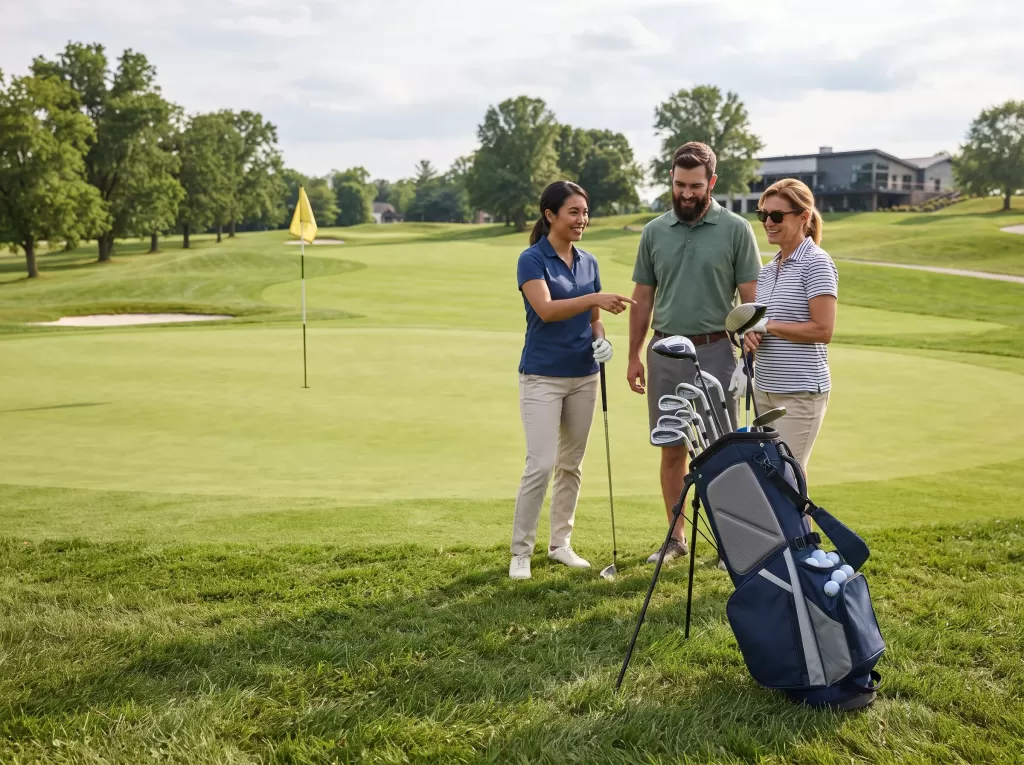
(For Illustrative Purposes Only)
Once I started viewing clubs as tools for specific situations rather than a collection to complete, equipment decisions became easier.
Every round requires a few types of shots: tee shots, long approaches, mid-range iron play, short shots around the green, bunker escapes, and putting.
A practical beginner bag covers all of those with around 8 or 9 clubs:
A driver for tee shots. A fairway wood or hybrid for longer approaches from the fairway. A set of irons, 6, 7, 8, and 9, for mid-range distances
A pitching wedge for shorter approaches. A sand wedge for bunkers and greenside shots. And a putter.
The hybrid was the single biggest equipment improvement I made as a new golfer.
The best golf hybrid for beginners was the single biggest equipment improvement I made as a new golfer.
Long irons looked simple enough, but they demanded more consistent contact and swing speed than I had developed.
A hybrid gave me a larger clubhead, easier launch, and more forgiveness from the same position.
For many beginners, swapping difficult long irons for hybrids makes the game noticeably more enjoyable.
When to Add Your 11th Through 14th Club
I used to think adding more clubs would fix weaknesses in my game. Whenever I saw another golfer pull out a specialty wedge or a different fairway wood, I wondered if I was missing something important.
Eventually I realized that buying clubs without understanding my own gaps was just expensive guessing.
A new club should solve a real, documented problem. If you regularly find yourself stuck between your pitching wedge and sand wedge distances, a gap wedge fills that hole.
If you regularly find yourself stuck between your pitching wedge and sand wedge distances, choosing the right gap wedge can fill that yardage gap.
If your driver feels uncontrollable but you need more distance from the tee than your 3-wood provides, a more forgiving driver might help. If your short game improves and you want more touch around the green, adding a lob wedge could make sense.
The principle I follow now: a club earns its place in your bag. Don’t buy something because another golfer owns it.
Buy it because your own rounds are telling you there’s a gap.
Complete Set or Individual Clubs

(For Illustrative Purposes Only)
One of the first real decisions I faced as a beginner was whether to buy a complete golf club set or build my bag one club at a time.
Building a custom setup sounded appealing. I imagined choosing the right driver, selecting the perfect irons, and curating a bag that looked exactly like what experienced golfers carry.
Then I looked at individual club pricing. A single iron set can run $500 to $1,200. Add a driver, fairway wood, hybrid, wedges, putter, and bag, and I was staring at a number that didn’t make sense for someone who hadn’t broken 120 yet.
What Comes Inside a Complete Golf Club Set
A typical beginner golf club set includes a driver, a fairway wood, a hybrid, irons (usually 6 through PW), a putter, a bag, and headcovers. Everything arrives matched and ready to play.
For someone learning the game, that removes a huge amount of uncertainty. You don’t need to spend hours researching whether your driver shafts match your iron shafts or whether your loft gaps make sense. The manufacturer has already done that work.
But not every complete set contains every club you’ll eventually want. Many beginner sets skip the sand wedge, which matters because bunker shots and high greenside approaches require one.
Most don’t include a lob wedge, though beginners rarely need one immediately. Some leave out additional hybrids that could replace harder-to-hit long irons.
The gaps are manageable. You can add a sand wedge for $35 to $80 later. But it’s worth knowing what’s in the box before you assume you’re fully equipped.
Why Matched Shafts and Consistent Loft Gaps

(For Illustrative Purposes Only)
The biggest advantage I found with complete sets was internal consistency. Every club felt like it belonged together. The shafts had similar characteristics. The weight distribution was balanced across the bag.
The loft spacing was designed to produce predictable distance gaps between clubs.
For beginners, this consistency matters because learning golf already involves enough variables. Your swing changes. Your distances shift. Your confidence fluctuates round to round.
Your equipment shouldn’t be adding extra confusion on top of all that.
Complete sets also provide better per-club value. At $400 to $700 for a full bag, you’re paying roughly $40 to $60 per club.
Buying comparable quality individually would cost double or more.
When Piecing Together Individual Clubs

(For Illustrative Purposes Only)
Complete sets work for most beginners, but there are situations where building a bag individually is the smarter move.
The first is when you already own some equipment. If you have a putter you’re comfortable with or a driver you hit well, buying a full set means paying for clubs you don’t need.
The second is when you have specific physical requirements: unusual height, faster-than-average swing speed, or a medical condition that affects your grip or stance. A club fitting can identify needs that no boxed set addresses.
The third is when you already know golf is going to be a long-term commitment.
A golfer who plans to play weekly might prefer upgrading in stages: irons first, wedges next, and driver later so they can make more informed choices as their game develops.
Graphite or Steel Shafts
(For Illustrative Purposes Only)
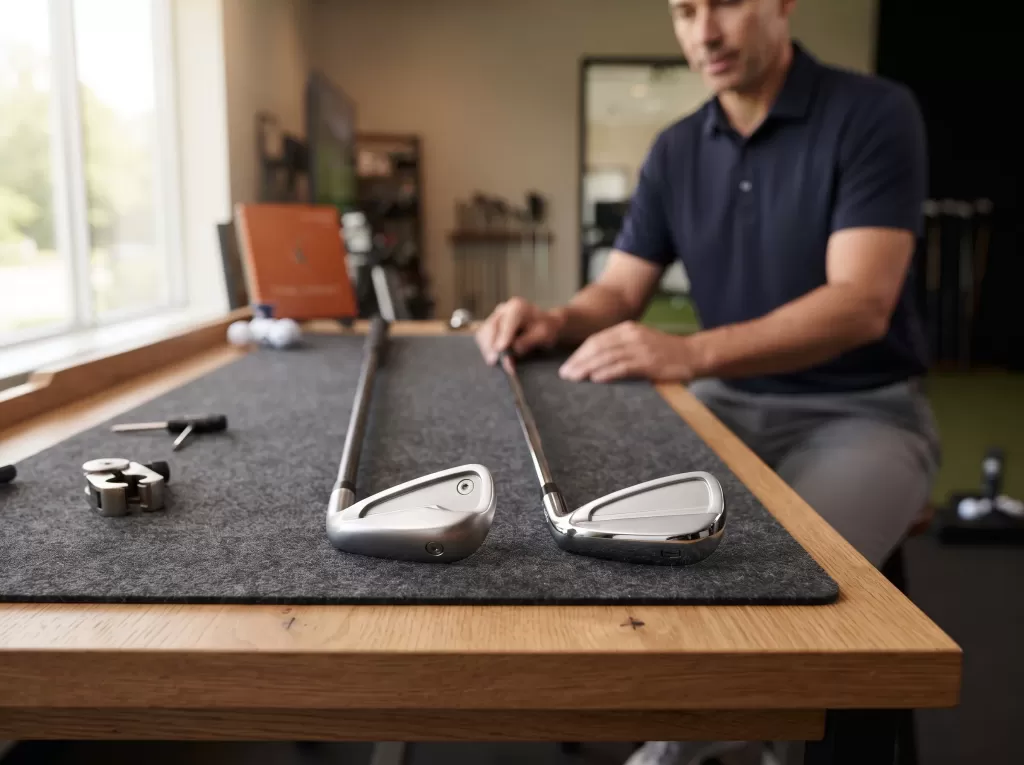
One thing I completely ignored when buying my first clubs was the shaft. I focused entirely on the clubhead and underestimated how much the shaft affects every part of the swing.
A shaft that doesn’t match your swing can make even well-designed clubs feel difficult. It’s the engine connecting your hands to the clubface, and it matters more than most beginners realize.
How Shaft Material Affects Distance, Feel, and Fatigue Over 18 Holes
Graphite shafts weigh between 60 and 80 grams. Steel shafts typically weigh 100 to 120 grams.
That difference might not sound like much, but across fourteen clubs over eighteen holes, it changes how your body feels by the back nine.
Graphite is lighter, which helps beginners generate more clubhead speed. It also absorbs vibrations better, meaning mishits don’t sting as much.
For golfers with moderate swing speeds, which describes most people still learning proper mechanics, graphite is usually the more comfortable starting point.
Steel shafts are heavier and provide more direct feedback. Some golfers prefer that firmer feel because it tells them exactly where contact happened on the face. Steel is also more durable and usually less expensive.
For roughly 90 percent of beginners, graphite is the better default. That said, a faster-swinging beginner who values feedback might do well with steel irons. It’s not a universal rule; it depends on the individual.
Matching Shaft Flex to Your Swing Speed

(For Illustrative Purposes Only)
Shaft flex determines how much the shaft bends during your swing, and choosing the wrong one creates problems that are hard to diagnose.
A simple matching guide based on swing speed:
Under 72 mph: Ladies flex. Between 72 and 85 mph: Senior or A flex. Between 85 and 96 mph: Regular flex. Between 96 and 110 mph: Stiff flex.
Playing a shaft that’s too stiff for your swing speed is worse than playing one that’s slightly too soft.
Too stiff produces low launch, a tendency to miss right, and lost distance. Too soft might close the face and pull shots left, but it at least gets the ball airborne.
If you don’t have access to a launch monitor, watch your ball flight. Shots that consistently fly low and fade right suggest too much stiffness.
Shots that balloon high and pull left suggest too little.
New vs. Used Golf Clubs

(For Illustrative Purposes Only)
I spent a lot of time debating this one before my first purchase. Both routes can work, and the right answer depends on how much research you’re willing to do.
Where to Find Quality Used Clubs
Used clubs can save serious money if you know what to inspect. Reliable sources include Callaway Pre-Owned, 2nd Swing, GlobalGolf, and local pro shops that carry trade-ins.
Before buying used, I check four things. First, the clubface: look for wear patterns, especially in the center. Heavy wear reduces performance. Second, run your fingers along the shaft, checking for dents, bends, or cracks near the hosel.
Third, worn grips need replacing, which adds $5 to $10 per club. Fourth, the overall cosmetics dings on the crown of a driver or deep scratches on iron soles suggest heavy use.
A general rule: avoid clubs older than five or six years. Technology in beginner equipment has improved substantially, and older models may lack the forgiveness features that make modern novice golf clubs easier to learn with.
When Buying New Makes More Sense

New clubs arrive with consistent specs, matching shafts, intact grips, and manufacturer warranties.
For complete beginner golf club sets specifically, buying new is often cheaper per club than assembling a used bag piece by piece.
There’s also a practical benefit for someone who’s never bought golf equipment before.
A new golfer doesn’t always know what “good condition” looks like in a used club. A new set removes that uncertainty entirely.
Mistakes That Cost Beginners Money and Confidence

(For Illustrative Purposes Only)
I made all of these. Looking back, avoiding even one would have saved me time and frustration.
Buying 14 Clubs Before You Know Which 8 You’ll Use
More clubs don’t improve your game. They just give you more options you haven’t learned to use.
Start with what covers the course, learn your distances, then fill gaps based on what your rounds actually tell you.
Choosing Clubs Based on What a Tour Pro Plays
Tour setups are built for players who swing at 115 mph and hit the center of the face almost every time.
Copying that configuration produces the opposite result for a beginner. What works at 115 mph with near-perfect contact doesn’t translate to 80 mph with inconsistent strikes.
Spending the Entire Budget on a Driver

(For Illustrative Purposes Only)
The driver is exciting. It’s the club everyone wants to hit first. But it’s also the least important club for a beginner’s scorecard.
Most of your strokes happen with irons, wedges, and your putter. Those clubs affect your score far more than the occasional long drive.
If your budget is limited, allocate it toward a forgiving iron set and a putter you can aim for before worrying about which driver has the newest technology.
Frequently Asked Questions
How many clubs should a beginner carry?
Starting with 8 to 10 clubs covers every situation you’ll face on a course.
A driver, fairway wood or hybrid, four or five irons, a pitching wedge, a sand wedge, and a putter give you a functional bag without overcomplicating decisions.
Should beginners buy a complete set or individual clubs?
For most new golfers, a complete set is the smarter starting point. You get matched shafts, designed loft gaps, and a full bag at a per-club price that’s difficult to beat when buying individually.
Building your own bag makes sense when you already own clubs or have specific fitting needs.
Are expensive golf clubs worth it for a new golfer?
Usually not at the very beginning. A forgiving $500 set that matches your swing will help your game more than a $1,200 set designed for better players.
Technology in today’s beginner golf club sets is remarkably good, even at moderate price points.
Should beginners get fitted for clubs?
It can help, especially if you’re unusually tall, unusually short, or have a swing speed that’s significantly faster or slower than average.
But most beginners will do fine with standard-length clubs in the correct shaft flex. Save the full fitting for when your swing stabilizes, and you know what you need.
Do beginners need a sand wedge?
It’s one of the most useful additions you can make. Bunker shots require one, and it’s also valuable for high, soft shots around the green.
If your complete set doesn’t include a sand wedge, adding one for $40 to $80 is worth it once you start playing courses with bunkers.
